
Gearbox Installation & Industrial Gearbox Installation Guidelines

Planetary gearboxes are widely used in modern industrial equipment due to their compact construction, high torque density, excellent load distribution, and superior mechanical efficiency when compared to conventional parallel shaft or bevel gear reducers. Their internal epicyclic arrangement allows torque to be transmitted through multiple planet gears simultaneously while maintaining a common load path axis, resulting in exceptional torque capacity within a minimal installation envelope. This makes planetary gearboxes particularly suitable for applications where space constraints, weight limitations, or high output torque requirements are critical design factors.
From a mechanical engineering perspective, the load‑sharing principle of planetary gear systems significantly reduces localized stress on individual gear teeth and bearings. By distributing torque evenly across several planet gears, these systems achieve higher allowable torque ratings with reduced component size. Additionally, planetary gearboxes typically exhibit low backlash, high torsional stiffness, and excellent dynamic response characteristics, which are crucial in precision motion control and high‑duty cycle industrial operations.
Despite their robust and highly engineered design, planetary gearboxes remain precision mechanical assemblies manufactured to tight dimensional, geometric, and tribological tolerances. Achieving the expected performance characteristics—such as rated output torque, mechanical efficiency, backlash stability, noise emission, vibration behavior, and thermal balance—depends not only on design and manufacturing quality, but very critically on proper installation practices. A gearbox that is incorrectly mounted, misaligned, improperly fastened, or incorrectly lubricated may experience abnormal stress states that exceed design assumptions, leading to premature degradation even if the unit itself is manufactured to a high standard.
Improper installation has consistently been identified as one of the dominant root causes of early planetary gearbox failure across industrial sectors. Typical installation‑related issues include shaft misalignment beyond permissible tolerances, uneven or distorted flange mounting surfaces, incorrect or uncontrolled bolt tightening, unsuitable or contaminated lubrication, and exposure to radial or axial loads that exceed the gearbox’s specified limits. These conditions often result in accelerated bearing fatigue, uneven gear tooth contact patterns, increased frictional losses, elevated operating temperatures, abnormal vibration signatures, and excessive noise levels, all of which contribute to reduced service life and unplanned downtime.
In many industrial environments, failures originating from installation errors are frequently misdiagnosed as manufacturing defects. This misinterpretation can lead to unnecessary replacement costs, extended downtime, and disputes regarding warranty coverage. In reality, non‑compliance with OEM installation instructions and engineering guidelines is often the primary contributing factor. Most gearbox manufacturers explicitly state that warranty validity depends on correct installation, lubrication, and commissioning in accordance with their technical documentation.
Correct installation of planetary gearboxes has a direct, measurable, and long‑term impact on key operational parameters, including:
- Service life of gears, bearings, seals, and internal components
- Available continuous and peak torque capacity under load
- Load stability and stress distribution across internal stages
- Mechanical efficiency, power losses, and heat dissipation
- Noise emission, vibration levels, and motion smoothness
- Functional safety margin and compliance with OEM warranty terms
Planetary gearboxes are commonly deployed in demanding industrial applications such as belt and chain conveyors, cranes and hoists, winches, mixers, extruders, rolling mills, paper and packaging machinery, heavy‑duty rotary tables, robotics, and automated production lines. These systems often operate under high dynamic loads, frequent start‑stop cycles, reversing motion, or continuous 24/7 duty conditions. Under such operating regimes, even minor installation deficiencies can be amplified, resulting in rapid degradation of gearbox components.
This article provides comprehensive installation guidelines for planetary gearboxes used in industrial equipment. It addresses the entire installation lifecycle, including pre‑installation inspection and verification, mechanical mounting and alignment principles, fastening and torque control practices, lubrication requirements, electrical and control integration considerations, commissioning and initial startup procedures, and post‑installation maintenance recommendations. The objective is to support engineers, maintenance personnel, and OEM system integrators in achieving engineered reliability, predictable long‑term performance, and reduced total cost of ownership.
Planetary Gearbox Supplier | Gearbox for Sale & price-SEAWIDE
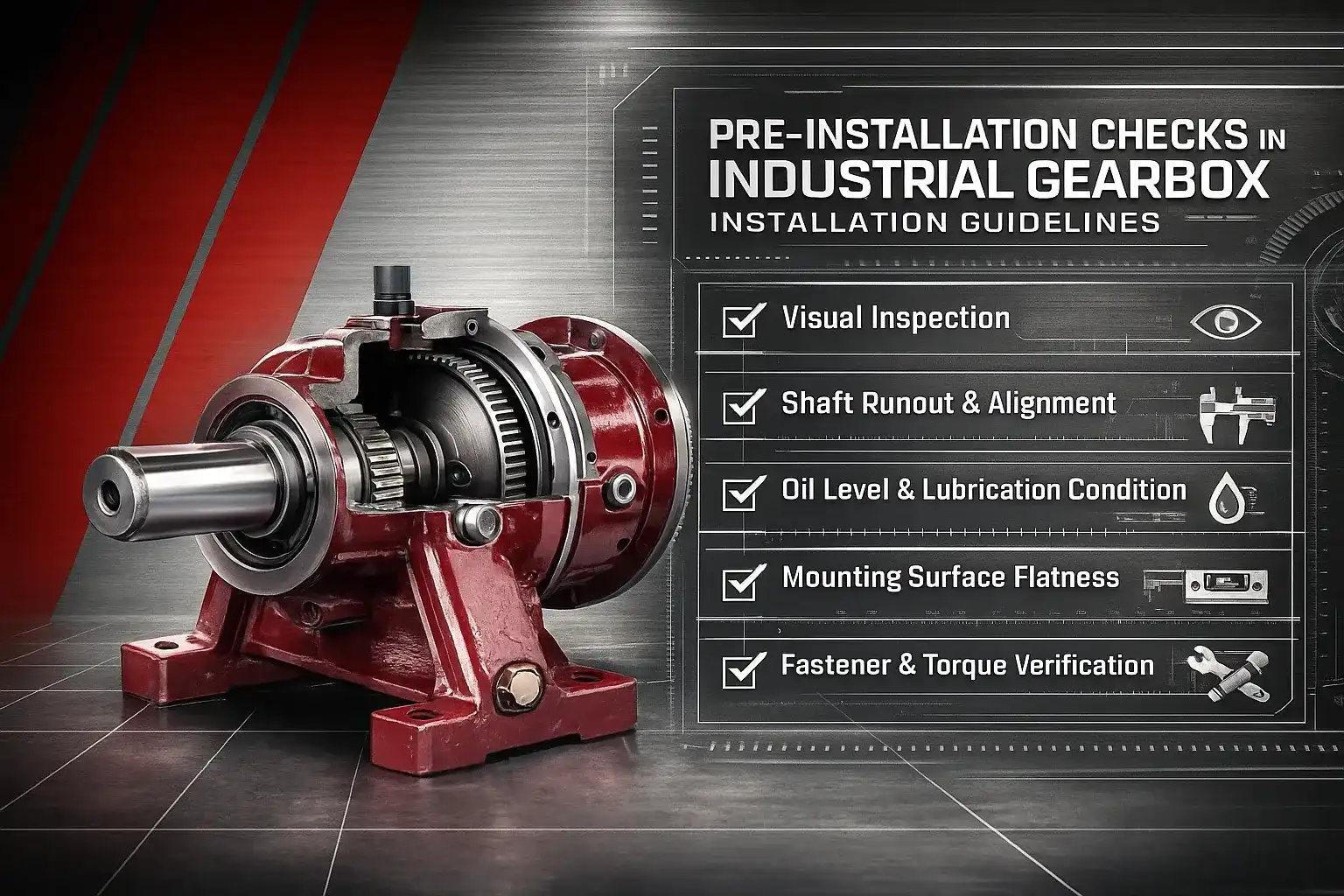
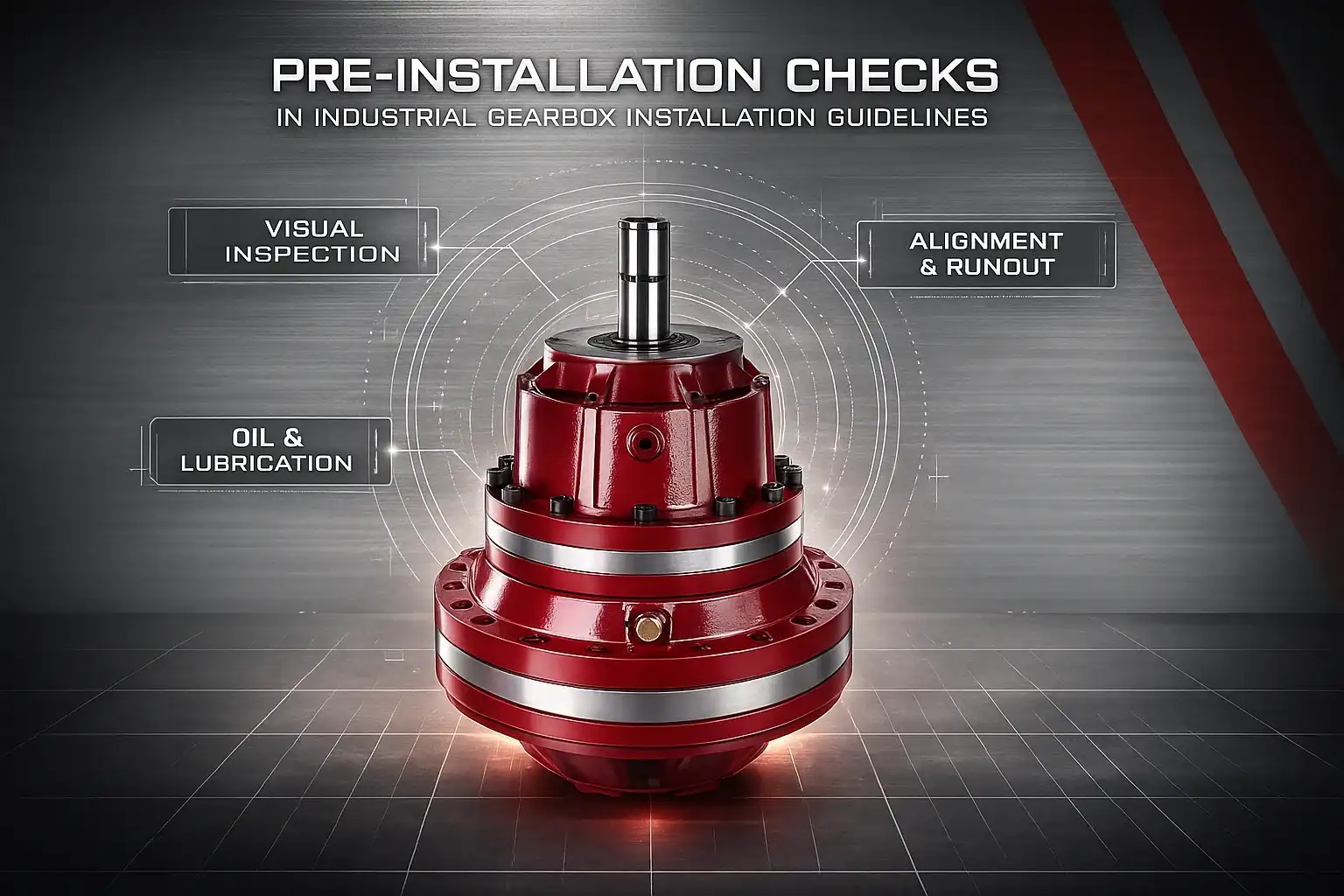
Pre‑Installation Checks in Industrial Gearbox Installation Guidelines
Industrial Gearbox Installation Guidelines , Before installing a planetary gearbox, thorough preparation and systematic verification are essential. Many installation‑related failures originate long before the gearbox is actually mounted, often due to incomplete planning, overlooked documentation, or improper site conditions. A structured pre‑installation phase significantly reduces the risk of errors during later stages.
Documentation Review
Prior to any mechanical work, the installer must carefully review all gearbox‑related documentation provided by the manufacturer or OEM. This documentation typically includes:
- Installation and operating manual
- Technical datasheets and dimensional drawings
- Lubrication and maintenance instructions
- Mounting position and orientation diagrams
Special attention must be paid to application‑critical parameters, including:
- Rated torque, peak torque, and service factor
- Transmission ratio and direction of rotation
- Permissible radial and axial shaft loads
- Tightening torque values for mounting and flange bolts
- Recommended oil or grease type and viscosity grade (ISO VG)
Failure to follow manufacturer‑specified values often leads to overloading, incorrect assembly, or unsuitable lubrication. Even minor deviations—such as incorrect torque values or oil viscosity—can have significant long‑term consequences. If documentation is missing, incomplete, or ambiguous, installation should not proceed until clarification is obtained directly from the gearbox supplier or OEM.
Industrial Gearboxes | High-Quality & Durable Solutions
Visual Inspection
Each planetary gearbox must be visually inspected immediately prior to installation, even if it is new and factory‑sealed. Transport, handling, or storage conditions may introduce damage that is not immediately obvious.
Inspection areas include:
- Housing: check for cracks, dents, deformation, or coating damage
- Shafts: inspect for corrosion, scratches, burrs, or keyway damage
- Seals: verify correct positioning and integrity of seal lips
- Flanges and mounting faces: ensure flatness, cleanliness, and absence of impact marks
The gearbox nameplate must be clearly legible and verified against the application requirements. Important data such as reduction ratio, mounting orientation, input/output configuration, rated torque, and serial number must match the engineering specification. Installing an incorrect gearbox variant can result in mechanical incompatibility, incorrect output speed, or insufficient load capacity, leading to costly rework and downtime.
Planetary Gearbox Supplier | Gearbox for Sale & price-SEAWIDE
Site Preparation
Proper site preparation plays a decisive role in installation quality. Even a correctly installed gearbox will suffer long‑term damage if mounted on an unsuitable structure or in a contaminated environment.
Key site requirements include:
- A flat, rigid, and dimensionally stable mounting foundation
- Surface flatness within OEM‑specified tolerance limits
- Clean, dry installation area free from dust, metal chips, or abrasive particles
- Clearly defined alignment references and datum surfaces
Gearboxes should never be mounted on flexible frames, twisted structures, or poorly welded bases. Structural deformation under load can distort the gearbox housing, leading to bearing misalignment and uneven gear contact during operation.
Mounting and Alignment Requirements per Industrial Gearbox Installation Guidelines
Correct mounting and alignment are among the most critical aspects of planetary gearbox installation. Due to their compact internal design and high bearing stiffness, planetary gear units are especially sensitive to misalignment, housing distortion, and external loading forces.
Output Shaft Mounting Practices inIndustrial Gearbox Installation Guidelines
Improper installation of components on the output shaft is one of the most common causes of damage in planetary gearboxes.
Key best practices include:
- Never apply hammering or impact loads directly to the output shaft
- Avoid mounting components by force or excessive tightening
- Use threaded pullers, hydraulic mounting tools, or thermal fitting methods as recommended
All mating components—such as couplings, sprockets, pinions, or hubs—must slide smoothly onto the shaft. For interference fits, controlled heating of the mounted component is preferred over forceful installation.
After installation, concentricity and radial runout must be checked using a dial indicator. Excessive runout causes cyclic bearing loading, accelerates fatigue failure, and increases vibration levels during operation.
Motor Installation
Planetary gearboxes are frequently driven by IEC or NEMA standard electric motors, either via direct motor adapters or through couplings.
Important considerations include:
- Verification of motor flange, shaft diameter, and shaft length compatibility
- Correct axial positioning of the motor shaft to avoid bearing preload
- Never pulling the motor into place using mounting bolts
Motor mounting bolts must be tightened in a cross‑pattern sequence using a calibrated torque wrench. Uneven or excessive tightening can distort the adapter flange and introduce misalignment between motor and gearbox input shafts.
For coupled configurations, flexible couplings must be aligned within the specified angular and parallel misalignment tolerances. Poor coupling alignment increases input bearing loads and may lead to premature bearing or coupling failure.

Radial and Axial Load Limits
Planetary gearboxes are designed to withstand defined radial and axial loads at the output shaft, which must not be exceeded during operation.
Key considerations include:
- Respecting permissible overhung load (OHL) limits
- Calculating actual radial forces from belts, chains, or gears
- Considering the distance of applied load from the shaft shoulder
If calculated loads exceed allowable limits, external bearing supports must be used to absorb the excess forces. Unsupported axial loads—often caused by rigid couplings, incorrectly installed equipment, or thermal expansion—are particularly damaging and can rapidly destroy bearings and seals.
Planetary Gearbox Supplier | Gearbox for Sale & price-SEAWIDE
Fastening and Torque Control According to Industrial Gearbox Installation Guidelines
Correct fastening is essential to ensure secure mounting without introducing harmful internal stresses.
Bolt Grade and Tightening
Only bolts of the specified strength class—typically 8.8 or 10.9—should be used. Using lower‑grade fasteners increases the risk of bolt failure under dynamic loads, while incorrect tightening procedures may distort the gearbox housing.
Best practices include:
- Cleaning bolt threads and contact surfaces
- Applying the recommended lubrication or thread‑locking compound
- Using calibrated torque wrenches
- Tightening bolts in a cross or star pattern
Industrial Gearboxes | High-Quality & Durable Solutions
Flange Mounting Accuracy
For flange‑mounted planetary gearboxes, precise alignment between mating surfaces is critical.
Key principles:
- Ensure parallelism of mounting surfaces within tolerance
- Avoid excessive or uneven shimming
- Never compensate for structural inaccuracies by over‑tightening bolts
Housing distortion caused by poor flange mounting leads to increased bearing friction, elevated temperature, and accelerated wear.
Lubrication Requirements Defined by Industrial Gearbox Installation Guidelines
Lubrication is a fundamental factor influencing gearbox performance, wear protection, and energy efficiency.
Factory‑Filled vs On‑Site Filling
Some planetary gearboxes are supplied factory‑filled, while others require filling during installation.
Key checks include:
- Confirmation of oil type and ISO VG viscosity grade
- Avoiding mixing of different oil formulations
- Filling according to specified volume and procedure
For grease‑lubricated gearboxes, only the specified grease type should be used. Incorrect grease selection can increase internal friction, reduce lubrication film strength, and damage seals.
5.2 Oil Level and Breathers
Oil level must be adjusted according to mounting position.
Best practices:
- Verify oil level after installation, not before
- Ensure correct positioning of vent plugs and breathers
- Keep breathers clean and unobstructed
Blocked breathers cause internal pressure buildup, leading to oil leakage and seal failure.
Planetary Gearbox Supplier | Gearbox for Sale & price-SEAWIDE
Electrical and Control Considerations within Industrial Gearbox Installation Guidelines
Electrical and control setup has a direct effect on mechanical loading of the gearbox.
Key aspects include:
- Verifying correct motor rotation direction prior to coupling
- Ensuring proper wiring of encoders and braking systems
- Configuring VFD parameters such as acceleration time, ramp profiles, and torque limits
Abrupt starts, high peak torque, or aggressive braking can overload gear teeth and bearings, especially in high‑inertia applications.
Initial Startup and Test Run
Commissioning should be performed in a controlled and documented manner.
No‑Load Test
Initial operation without load allows detection of installation errors.
Monitor:
- Noise and vibration behavior
- Smoothness of rotation
- Temperature rise over time
Abnormal noise or rapid temperature increase typically indicate misalignment or lubrication issues.
Load Commissioning
Load should be introduced gradually.
Key steps:
- Increase load in stages
- Monitor electrical current, vibration, and temperature
- Verify backlash and smooth torque transmission
All mounting bolts should be re‑checked after the first operating hours.
Planetary Gearbox Supplier | Gearbox for Sale & price-SEAWIDE
Common Installation Errors and Failure Prevention in Industrial Gearbox Installation Guidelines
Typical installation mistakes include:
- Shaft and coupling misalignment
- Incorrect lubrication type or oil level
- Over‑tightening of mounting bolts
- Unsupported radial or axial loads
Systematic adherence to installation guidelines prevents these failures and significantly increases gearbox service life.
Maintenance Recommendations After Installation
Post‑installation maintenance is essential for long‑term reliability.
Recommended actions:
- Perform the first oil change according to OEM intervals
- Periodically verify bolt tightness
- Monitor vibration, temperature, and noise trends
Early detection of deviations enables corrective action before catastrophic failure occurs.
10. Conclusion
Correct installation of a planetary gearbox is a critical prerequisite for achieving its designed torque capacity, efficiency, and service life. By following structured installation guidelines—from pre‑installation verification to commissioning and routine monitoring—industrial operators can substantially reduce the risk of premature failures, unexpected downtime, and unnecessary repair costs.
Strict adherence to OEM installation recommendations ensures engineered reliability, superior performance, and full warranty compliance, making proper gearbox installation an essential component of successful industrial drive system operation.
3 Comments
zoritoler imol
says:Perfect work you have done, this website is really cool with great info .
AhmdReza Agb
says:Thank you very much for your kind feedback.
We’re glad you found the website informative and useful.
More technical content and product documentation will be added continuously.
Modular Design Strategies Used by OEMs - Engineering Knowledge Base
says:[…] between coupling technologies and drivetrain stiffness behavior. Supporting references such as industrial gearbox installation guidelines are useful here, especially when interface behavior is as important as nominal torque […]